
Symbols of Nature
The Dragon Tree and the Blue Chaffinch
The Dragon Tree is considered, according to a law of the Government of the Canary Islands (Law 7/1991 on symbols of nature for the Canary Islands), the plant symbol of the island of Tenerife, along with the blue chaffinch, as its animal symbol.
The Teide Blue Chaffinch
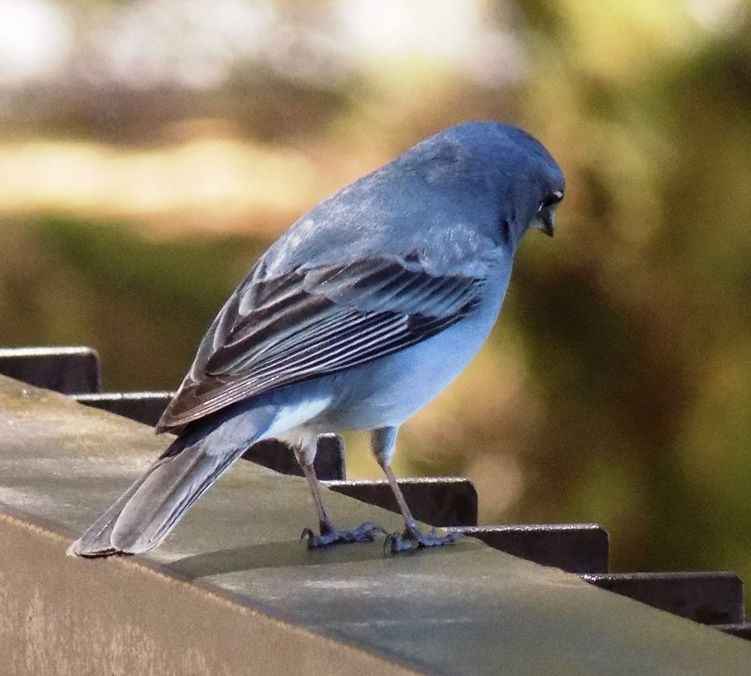
The Teide Blue Chaffinch (Fringilla teydea), also known as the Teide bluebird and summit bird, is, in all likelihood, the most beautiful and distinctive endemic species of the Canary Islands' avifauna. Within its genus, it is the largest and most robust species, also notable for the great strength and length of its beak, undoubtedly adapted to its diet: the seeds of the Canary pine.
The male's plumage is bluish-gray, with striking blackish wings and tail, as well as a white eye-ring; The female is brownish-gray. The typical subspecies of Tenerife lives and nests in the pine forest belt surrounding the high mountain zone (1,000–2,000 m).
At 16–18 cm in total length, it is the largest of the three existing chaffinch species in the world. It exhibits marked sexual dimorphism, with the adult male being a deep blue on the back and lighter on the underparts, with a relatively long tail, a fairly prominent (discontinuous) eye-ring, and a robust beak. The subspecies *F. t. polatzeki* differs from the nominate subspecies (*F. t. teydea*) primarily by having two clearly visible white wing bars, as well as by its song. The female is brownish-olive on the back, contrasting with lighter tones on the belly and two wing bars, which are more prominent in the *polatzeki* subspecies.
This is a Canary Island endemic species, found only on the islands of Tenerife (F. t. teydea) and Gran Canaria (F. t. polatzeki). It is a faithful inhabitant of Canary pine (Pinus canariensis) forests, both in drier formations and in humid, mixed-type forests with an understory of laurel forest or heathland; in the latter, it often coexists with the common chaffinch (Fringilla coelebs). Altitudinally, it occurs between 1,000 and 2,000 m, although it is sometimes observed at lower elevations, especially in winter. On Tenerife, the blue chaffinch has a wide distribution, occupying practically the entire "forest crown" surrounding Teide National Park.
It shows a strong preference for those parts of the pine forest where the understory consists mainly of broom shrubs, and it is here that its populations are most numerous, even in replanted pine forests. It appears that during the breeding season, they obtain most of the insect larvae they feed their chicks from broom bushes, especially lepidopteran caterpillars.
Their diet consists mainly of pine seeds (pine nuts) and invertebrates (primarily nocturnal lepidopterans and beetles). Regarding reproduction, the usual clutch size is two eggs, which are laid in a cup-shaped nest, almost always located in a Canary Island pine, and more rarely in other trees, between 1.5 and over 20 meters high. The breeding season extends from mid- to late spring through summer (late May and early June), making it a late breeder. In Tenerife, it frequently migrates to higher altitudes towards the high mountain scrubland, generally in summer, and is commonly seen in areas with water. The typical subspecies is quite common and does not face serious conservation problems, while F. t. polatzeki is considered "Endangered," as it has a much smaller population (around 200 individuals in the wild) and is subject to serious threats, such as forest fires, habitat fragmentation, and human disturbance. Fortunately, for several years now, a huge effort has been underway to protect and conserve these birds, resulting in the (re)colonization of new areas and the establishment of a breeding stock capable of reproducing in captivity, alongside the restoration of their habitat.
DRAGON TREE: Description and Distribution
Common name: Dragon Tree
Species: Dracaena draco (L.) L. subsp. draco
Order: Asparagales Link
Family: Asparagaceae Juss. (Agavaceae family)
Subfamily: Nolinoideae Burnett
Tribe: Dracaeneae Dumort.
Genus: Dracaena Vand. ex L.
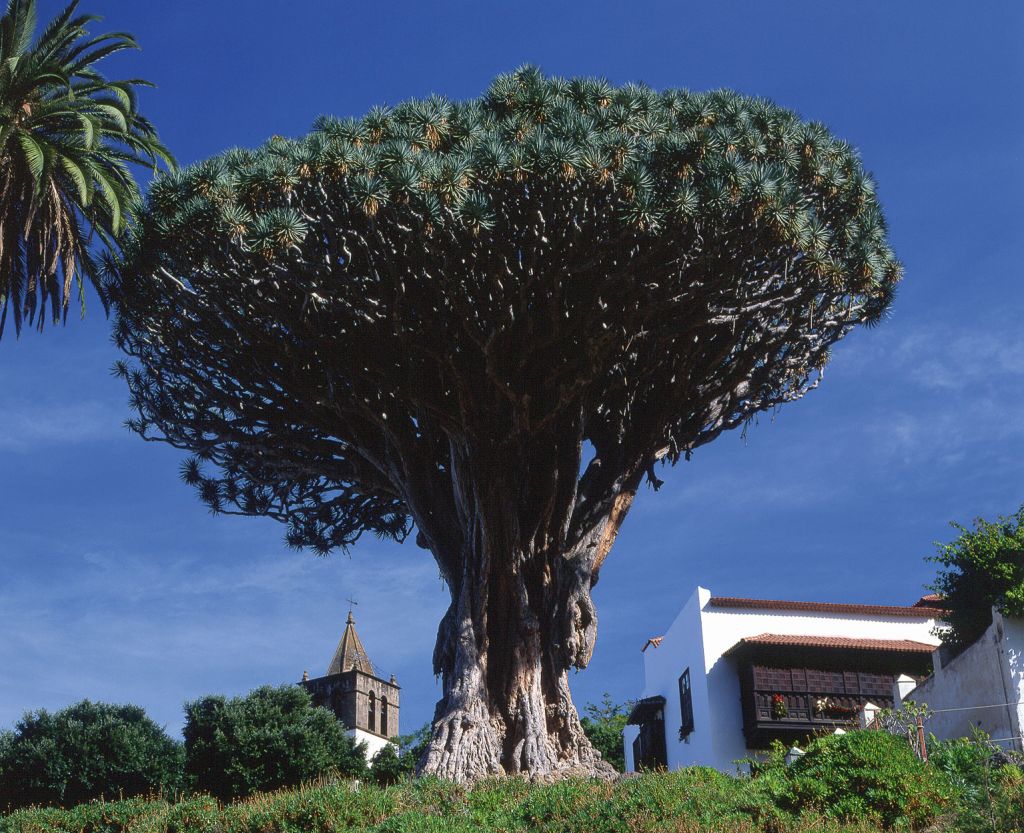
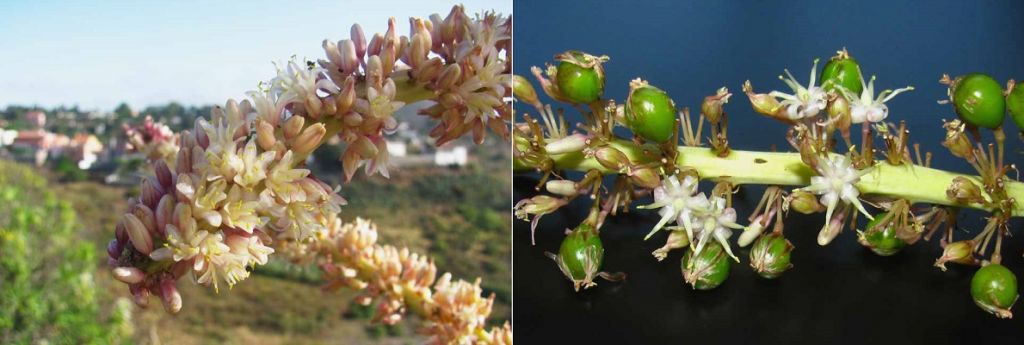
This species is a Macaronesian endemic in the broad sense. It has three subspecies: the ajgal Benabid & Cuzin subspecies, endemic to Morocco in the Moroccan Anti-Atlas Mountains and recently described (1997); the Cape Verdean subspecies Marrero-Rodr. & R.S. Almeida, endemic to Cape Verde and even more recently described (2012); and the type subspecies, which is a Canary-Madera endemic of the thermophilic forest. This subspecies is also present in the Azores, but it is considered introduced in that archipelago. In the Canary Islands, it grows wild or naturalized on all the islands except Lanzarote and Fuerteventura; it is distributed across El Hierro, La Palma, La Gomera, Tenerife, and Gran Canaria, although some authors only consider it native to the central islands. It is a tree-like plant, though without true wood, that can reach up to 20 m in height, with a dense, umbrella-shaped crown, a grayish trunk, and branches at a certain height that form a dense canopy. The flowers are clustered in apical racemes, and the fruits are globose, orange when ripe.
It is characterized by its aerial roots, which sometimes fuse with the base of the thick, erect trunk, and its dichotomous branching (the branches divide into two similar ones from the apex), which only occurs after flowering. Therefore, unbranched dragon trees have not reached sexual maturity, while older specimens typically have a highly branched, fan-shaped crown.
The bark displays a mixture of reddish, gray, and even silvery tones and is almost smooth. The sword-shaped, glaucous, leathery leaves, reddish at the base, grow in dense rosettes at the branch tips. The inflorescences are terminal panicles with greenish-white tepals. The leaves are simple, up to 60 cm long, flat, pointed, flexible, whitish-green, and sword-shaped. They appear grouped in very compact tufts at the ends of the trunk or branches, to which they are attached by a kind of orange sheath, thus lacking a petiole. During the summer, large, highly branched inflorescences with many flowers emerge, attracting bees with their nectar and pollen. The flowers are hermaphroditic, creamy white, sometimes with pinkish hues. The fruits are fleshy, spherical berries, up to 1.5 cm in diameter, turning orange when ripe. They contain 1 or 2 seeds.
Ecology: This species is very undemanding in terms of soil type, making it suitable for landscaping in any terrain. It prefers a temperate climate, sunny exposure, sandy loam soils, and a neutral pH. Primarily a rock-dwelling species, in its natural state it typically survives in inaccessible places, such as ledges and ledges of escarpments and vertical cliffs, but also on moderately steep slopes and piedmonts, within the potential area of the thermophilic forest. Dragon tree populations usually occur in association with species of rock-dwelling scrubland.
The dragon tree is a plant native to thermophilic forests, although it sometimes grows in the lower reaches of the laurel forest and can even be found in association with pine forests; this is the case of the dragon tree grove in the Barranco de Badajoz ravine (Tenerife). It generally prefers areas influenced by the humid trade winds and other damp locations, and thrives between 100 and 700 meters above sea level.
In Tenerife, its populations, generally small and widely dispersed, are located almost entirely in the oldest geological areas of the island: the Anaga, Teno, and Adeje massifs. According to experts, there is only one wild specimen in Gran Canaria, in the Barranco de Pino Gordo ravine (San Nicolás de Tolentino), and two other semi-wild specimens, in Meleguinas and the Barranco Alonso ravine (Santa Brígida).
Ethnobotany
Uses in gardening
The dragon tree is widely cultivated for its beauty and uniqueness, as well as for its climatic and soil adaptability. Individual specimens or groups are planted, sometimes alongside other species of the thermophilic forest. It is frequently used in parks, gardens, plazas, roundabouts, and along roadsides.
General Uses
Its sap, fruit, leaves, and bark are all utilized. It has anti-inflammatory, antitussive, and anti-ulcer properties. It is used as forage, in crafts, for making rope, as a tanning agent, for dyes, and for protective armor.
The sap of this plant turns red upon contact with air, hence its name, "dragon's blood." It was very popular among the Canary Island aborigines, who used it for medicinal purposes, in the mummification of corpses, to waterproof leather bags, and as a hair dye.
The Guanches also used the trunks for boat building and the bark for making slings, drums, tambourines, household containers, and shields. The leaves and roots were used for basketry, rope making, and fishing nets. Furthermore, in Gran Canaria and Tenerife, coffins were made from its bark and burial platforms from its leaves, attesting to the symbolic importance of this species for the archipelago's population.
The dyeing and pharmacological properties of dragon's blood meant that this species was known in Imperial Rome, almost 2,000 years ago. Thus, Pliny, in his Natural History, refers to this sap and mentions that it comes from the Canary Islands.
After the conquest, the dragon tree began to be exploited for the construction of houses and canals, and for making beehives, barrels, grain measures, and beds. The sap, for its part, was used to clean and protect swords from rust, to dye objects, or, mixed with the latex of the sweet spurge (Euphorbia balsamifera), as sealing wax for letters.
The use of dragon's blood continued to spread throughout Europe and, apparently, it was one of the ingredients with which Venetian ladies obtained the dye for their famous golden hair. It was also used to tan hides and obtain red-toned paints, varnishes, and lacquers that were very popular among luthiers.
Its leaves have also been used as fodder for livestock and in basketry, an activity that has continued since ancient times. Ropes, very useful for tying vines or stringing fish, have been obtained from its bark, leaves, or roots. The hollow trunks were used to make corks for beehives and containers for storing salt—in La Palma, the word 'tajoque' is used to refer to these containers.
The dragon tree has been traditionally used to strengthen gums, heal wounds or bleeding ulcers, and treat coughs and colds. It is also noted that, due to its sapogenin and flavonoid content, it has anti-inflammatory, hemostatic, and healing properties.
This species is listed in the Canary Islands Catalogue of Threatened Species under the category "Species of interest for the Canary Island ecosystems."
The genus name Dracaena comes from the Greek word drakaina, meaning dragon or serpent, or more likely from the expression "dragon's blood," which its sap was said to contain; the epithet draco is the Latin word for dragon tree.
The Dragon Tree in Legend
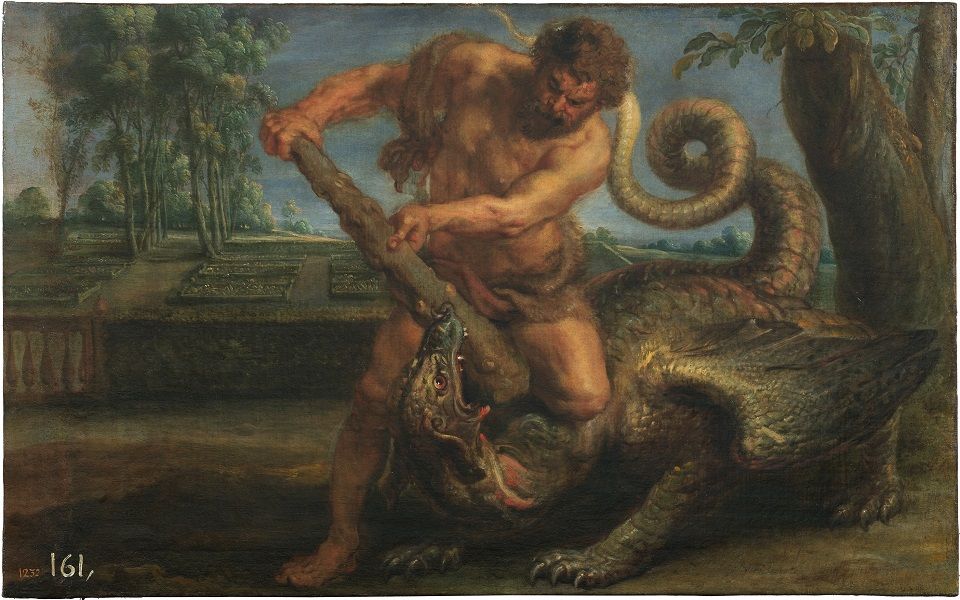
According to legend, the dragon tree is associated with the dragon tasked with guarding the golden apples that grew on the trees of the Garden of the Hesperides (often located in the Canary Islands), as this golden fruit granted immortality.
Mythology tells that beyond the Pillars of Hercules (a place the Greeks located at the Strait of Gibraltar) lay the famous Garden of the Hesperides. The Hesperides were seven in number, lived in Mauretania, although other mythical traditions place them in the Canary Islands, and cultivated a magnificent garden, whose trees, laden with golden apples, stirred the greed of both men and gods. These apples had been given by Gaia, Mother Earth, to Hera on the occasion of her marriage to Zeus. A seven-headed dragon guarded the precious fruit and stood at the garden's entrance with its eyes always open.
Eurystheus had ordered Hercules to perform Twelve Labors, one of which was to steal the golden apples. Hercules had to overcome many dangers, but the worst was facing the dragon that guarded the garden. After a fierce fight, he managed to kill it and seize the golden apples. The Hesperides warned him that the gods would not allow it and that the apples would be returned to their rightful place. When Hercules took the apples to Eurystheus, he told him of the Hesperides' warning, so the cunning Eurystheus rewarded Hercules with them for his courage. Hercules immediately took them to the goddess Athena, who returned them to their place.
The Hesperides are also known as the Atlanteans or the Pleiades. They all married gods or heroes, and after their deaths, they were placed in the sky, forming the Pleiades constellation. The Guanches, the ancient inhabitants of Tenerife, worshipped the dragon tree as their guardian spirit and attributed healing properties to it, using its red sap to prepare potions employed in esoteric rites. They believed this sap came from the blood of dragons, although in reality, the sap is colourless and only acquires reddish tones upon contact with air and light. The dragon tree was a totemic element, and the council of elders would gather around it to administer justice in the name of the god Acorán. The people also commemorated religious festivals around it.
The illustrious historian José de Viera y Clavijo, in his Dictionary of Natural History of the Canary Islands, refers to the fact that dragon's blood was not only used medicinally, but was also highly sought after for making dyes, varnishes, and as animal fodder—uses that could still be relevant today.
This unique tree was brought to Europe after the conquest of the Canary Islands, and its trade was so important that it was subject to tithes. Some Catalan and Portuguese navigators used to inscribe their names on dragon trees (as they also did on African baobabs) as a sign of possession and occupation of the islands they discovered.
The Romans were already familiar with dragon's blood, which they called "Cinnabaris," according to Pliny, and came to the islands in search of it for medicinal purposes; they paid high prices for the sap, which was used by Roman women to make cosmetics. During the Middle Ages, "dragon's blood" was believed to have properties that could combat leprosy.
Much speculation has been made about the age these trees can reach. Alexander von Humboldt, one of the first illustrious researchers of the Canary Islands, recounts that a dragon tree specimen from Tenerife, located in the Orotava Valley (destroyed by a hurricane in 1867), had a circumference of 15 meters and was over 6,000 years old, which would classify it as a true living fossil.
Image: "Hercules Slaying the Dragon in the Garden of the Hesperides" (Rubens, Peter Paul and workshop)
Image copyright © Museo Nacional del Prado
https://www.museodelprado.es
The "Millennial Dragon Tree" of Icod de los Vinos
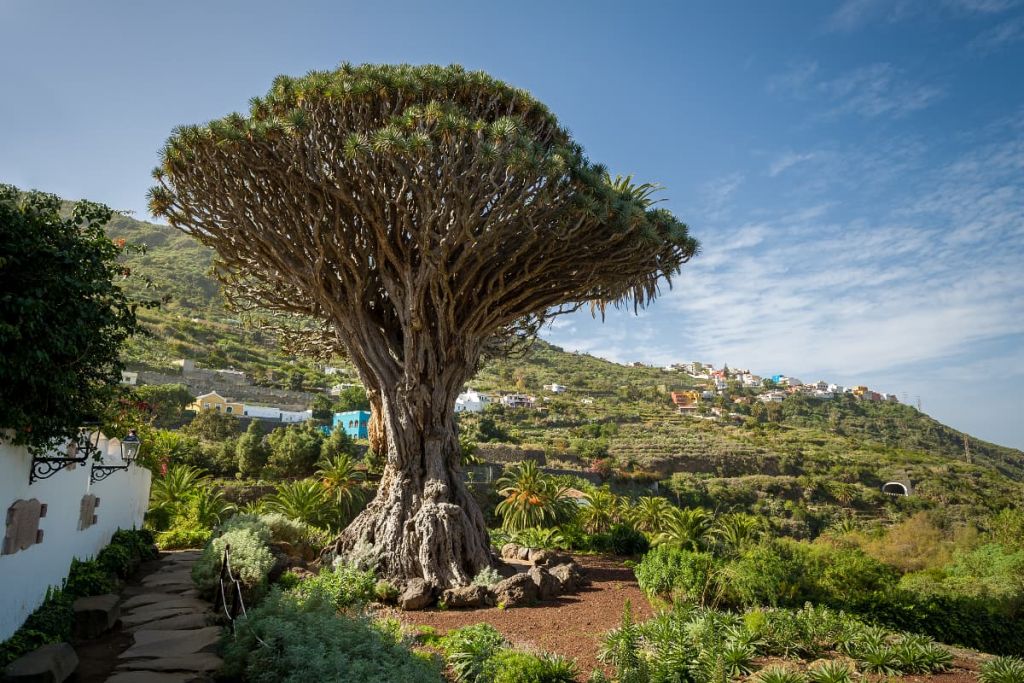
Many dragon trees exemplify the majesty of this species, but undoubtedly the most famous is the "Millennial Dragon Tree" of Icod de los Vinos, a botanical symbol of the island of Tenerife. It has always been considered to be thousands of years old, around three thousand years, but recent studies suggest it is hundreds of years old. It measures approximately 20 meters in height and 16.40 meters in circumference at its base. Its crown is enormous, with nearly 300 branches and a weight of about 80 tons. Inside its hollow, chimney-like interior, accessed through a small door, a thermometer, a hygrometer, and a fan have been installed to control the humidity.
Local farmers predict the state of their crops by the tree's blossom, as these trees act as true biological clocks. When it blooms from the south, the winter will be rainy on the coast. If it blooms from the north, it will only rain in the mountains. However, when the entire canopy blooms, the rains will be widespread. In 1995, it produced a spectacular bloom, with the flowers increasing its weight by 2.7 tons, from which tens of thousands of seeds were germinated. This summer flowering heralded the end of one of the worst periods of drought ever recorded in Tenerife.
The Drago Park
It is currently surrounded by a beautiful park, the Drago Park, which is located around the important historical and artistic heritage site of Icod. It covers an area of more than three hectares and is full of native plants of our islands. Along its paths, the different bioclimatic zones of Tenerife are showcased, as well as a garden of Canarian medicinal plants, in addition to several ethnographic areas representing various traditions of Icod de los Vinos. From the Caforiño ravine, a route begins through laurel forests, leading to a viewpoint overlooking the Drago tree with Mount Teide in the background. Afterwards, various paths lead to different areas of the park. A small bridge connects the banks of the aforementioned ravines.
Monumental Dragon Trees of Tenerife
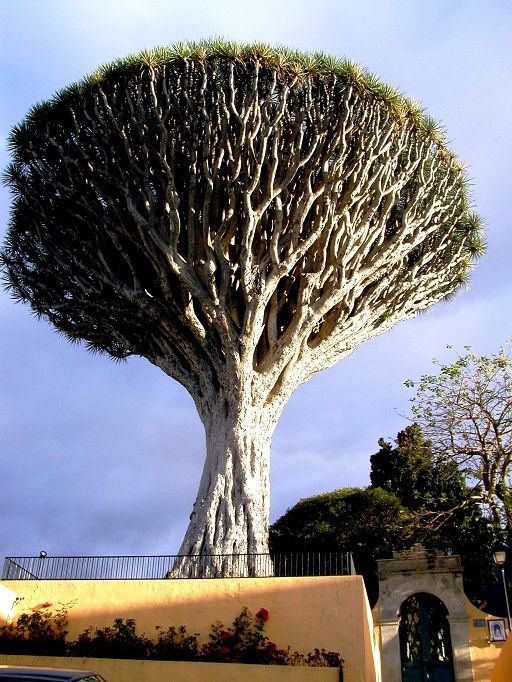
Tenerife is the island with the highest concentration of monumental dragon trees, starting with the famous dragon tree of Icod, the town where the San Antonio dragon tree also stands. In La Laguna, the historic Seminary dragon tree (currently in very poor condition), the Cho Marcos Ratón dragon tree in Tejina, the Valle Tabares dragon tree, and the San Miguel hermitage dragon tree in Valle Guerra are noteworthy. In Los Realejos, the San Francisco and Siete Fuentes dragon trees are both very beautiful. In Tacoronte, there is the San Juan dragon tree (with 23 flowering periods, the same as the Icod dragon tree), the Don Lucio dragon tree, the Cubano dragon tree, and the deteriorated Cristo dragon tree, located on the outskirts of the town. In Tegueste, there is the Montaña Los Dragos dragon tree and the Prebendado Pacheco dragon tree. In Güímar, there are the La Raya and Buen Retiro dragon trees. In Santa Cruz, there is the Cura dragon tree in Taganana; In El Sauzal, the dragon tree of the Servant of God; in Puerto de la Cruz, the one at Sitio Litre; in Buenavista del Norte, the dragon tree of the Hacienda del Conde; and in Guía de Isora, the one in Chiguergue. Other notable dragon trees include: the one in the Agua de Dios ravine, the one on the Camino de Las Peras, the one in the courtyard of the old Casa Izquierdo, the one in the Plaza de la Concepción and the one on the San Francisco estate, in La Laguna; the dragon trees of La Quinta, at the entrance to the former home of Jorge Víctor Pérez, in Santa Úrsula; those of La Dehesa, La Mocana and La Candelaria del Lomo, in La Orotava; the one on the cliff of La Paz, in Puerto de la Cruz; the one at Buen Paso, in Icod; the one at La Culata, in Garachico; and the one at the Nazaret school, in Güímar. In recent times, several distinguished specimens have disappeared, such as the dragon tree of San Bartolomé de Geneto (a victim of urban development) and the one on Calle del Agua (now Calle de Nava y Grimón), both in La Laguna, and the one at the former Hotel Pino de Oro in Santa Cruz.
The Dragon Trees of Los Realejos
Los Realejos has been blessed by nature with the great variety and number of these trees found in its surroundings. Among the most notable for their longevity and beauty are the dragon trees of San Francisco in Realejo Bajo and Sietefuentes in San Agustín, both large specimens several hundred years old; the twin dragon trees of Realejo Bajo; the dragon tree of Rambla del Mar, which rises above the green canopy of banana plantations, creating a spectacular image of the Realejos coast; the dragon trees of Tigaiga, with their wild appearance and twin-like growth habit; and the one of Rambla de Castro, a beautiful specimen emerging from the famous palm grove.
On Wednesday, March 4, 2026, the historic dragon tree of San Francisco, also known as the Dragon Tree of Buenpaso or the San Francisco Cemetery Dragon Tree, 17 meters tall and over 200 years old, collapsed as a result of the intense rains and strong winds of a storm. It was one of the most imposing dragon trees in the Canary Islands and appears in the image. Travelers and writers of other eras have said of it that “its appearance is strange, one might say that of an enormous candelabra supporting a forest of yuccas. It is certainly one of the rarest plants in creation, and many have believed they saw beneath its canopy the image of the dragon of fable, guardian of the golden apples of the Garden of the Hesperides.”
Wild Dragon Trees in Tenerife
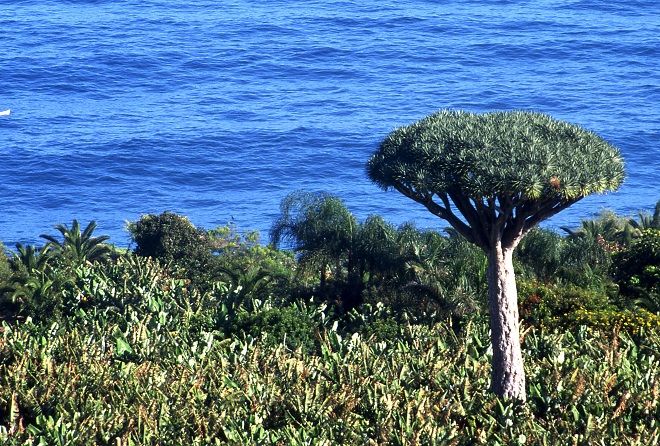
According to data from the Atlas and Red Book of Threatened Vascular Flora of Spain (2003), the estimated population in Tenerife is 696 individuals. This study excluded the most anthropized and urbanized potential areas: Güímar Valley, Santa Cruz-La Laguna metropolitan area, Tacoronte-Acentejo region, La Orotava Valley, and Icod region.
In general, it inhabits environments directly or indirectly influenced by the trade winds, in frequently inaccessible or difficult-to-reach places, such as cliffs, crags, and ravine slopes, coexisting with various thermophilic, xerophytic, and rupicolous species. Its optimal altitudinal range lies within the thermophilic vegetation zone and the upper edge of the cardonal-tabaibal scrubland, between 100 and 600 meters, although extreme elevations range from 30 to 975 meters. Its small and fragmented populations are located almost entirely in the oldest geological areas of the island: the Anaga massif (in the northeast), Teno massif (in the northwest), and Adeje massif (southwest).
Anaga constitutes the main area, with a total of 445 specimens recorded, mostly on the northern slopes of the massif. The best examples are found in the Taborno ravine, Roque de Tierra, Roque de las Ánimas-Roque de Enmedio, Igueste ravine, Roque del Aderno-Montaña Tafada, Afur ravine-Cañada de la Pesquería, Río-Aguaide-Chinamada ravine, and Benijo-El Draguillo. They also appear in the Vargas ravine and on the cliffs of Bajamar towards Punta del Hidalgo, between Roque Dos Hermanos and Punta de Tamadite, in the Seco ravine, Roque del Paso, Roque Marrubial, Taganana (Azanos), Las Palmas, the Roque Bermejo-Chamorga ravine, Montaña de Las Toscas (Antequera), and the Balayo ravine.
In Teno, 84 specimens have been recorded growing on the paleocliffs of the lower island between Buenavista del Norte and Los Silos (Cecilia, Ravelo), as well as in the Cochinos ravine, the Blas ravine, the Interián cliffs, and to a lesser extent in Masca and other nearby ravines, where some scattered specimens survive. In the Adeje massif, dragon trees are concentrated in the Barranco del Infierno ravine and the adjacent Barranco del Agua ravine, with an estimated population of 161 individuals rooted in the escarpments of both ravines, while a single tree grows in the nearby Barranco del Rey ravine. Outside these main areas, three dragon trees survive in the Barranco de Badajoz ravine in Güímar and another two in the Barranco de Guaría ravine in Guía de Isora.
Dragon tree groves
This term refers to a possible plant formation dominated by dragon trees (Dracaena spp.), which may have existed in the past in the Canary Islands, but which in any case is not currently found, since the famous dragon tree grove of Buracas in Las Tricias (La Palma) has a recognized anthropogenic origin. The remaining natural dragon trees in the Canary Islands are very scarce and are only found on the most inaccessible cliffs of Anaga, Teno, Güímar, Arona, Adeje, and Guía de Isora in Tenerife (D. draco) or in southern Gran Canaria (D. tamaranae) (Almeida, 2003), as is the case on other Macaronesian islands (São Jorge, Madeira, Santo Antão, São Nicolau, and Fogo). However, the stand of dragon trees that survives on the summit of Roque de Tierra in Anaga, at an altitude of 190 m and beyond the reach of goats, consisting of some 30 to 50 adult individuals, suggests that this formation may have existed, and even been abundant, in the past, before the colonization of the Canary Islands by humans. A similar situation to the one described occurs in other locations in Anaga, especially at Roque de Las Ánimas (Taganana) and the Taborno ravine, where there are several dozen specimens on the cliffs. Perhaps future research will shed more light on whether or not natural dragon tree colonies existed in the Canary Islands.